
By Becca Schild
It’s no overstatement to say that those who live in and visit Colorado are drawn here by world-class recreation opportunities and a stunning natural environment. These landscapes—and the amenities they provide—are the foundation of our local economies and the high quality of life we enjoy. However, climate change and development are threatening biodiversity, ecosystem health, and wildfire resilience. At the same time, increasing recreation pressure is placing significant strain on trails, rivers, and open spaces.
In response to these challenges, Governor Jared Polis established the Colorado Outdoor Regional Partnership Initiative in 2020. The initiative aims to balance rising recreation demand with conservation needs across the state. It encourages regional coalitions with diverse representation—including conservation organizations, recreation groups, agricultural stakeholders, and local governments—to collaborate on shared solutions.
Initial planning grants were distributed through Colorado Parks and Wildlife (CPW) to support the formation of these partnerships. Today, 24 regional coalitions are advancing Colorado’s Outdoor Strategy, which builds on the regional partnership initiative and outlines a roadmap for integrating conservation, recreation, and climate resilience. The strategy also includes a significant funding commitment: a five-year, $50 million appropriation administered by Great Outdoors Colorado (GOCO) and CPW.
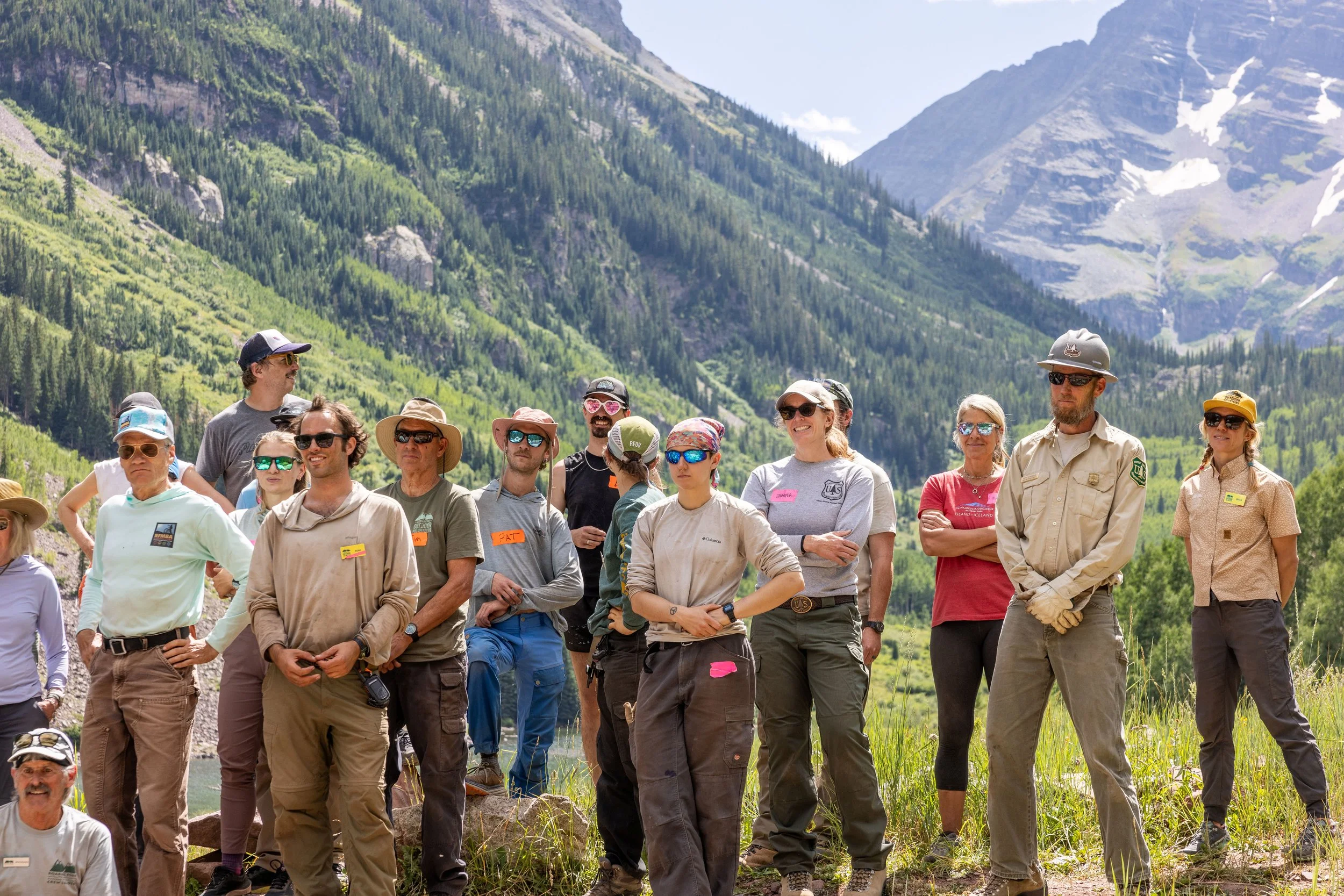
The Roaring Fork Outdoor Coalition (RFOC) formed in 2022 with nine core land management partners: the Bureau of Land Management (BLM), Colorado Parks and Wildlife, the City of Aspen, the City of Glenwood Springs, Eagle County, Pitkin County, the Town of Basalt, the Town of Snowmass Village, and the U.S. Forest Service’s Aspen–Sopris Ranger District. The coalition launched a two-year planning process that engaged hundreds of stakeholder organizations and thousands of residents through regional listening sessions and surveys.
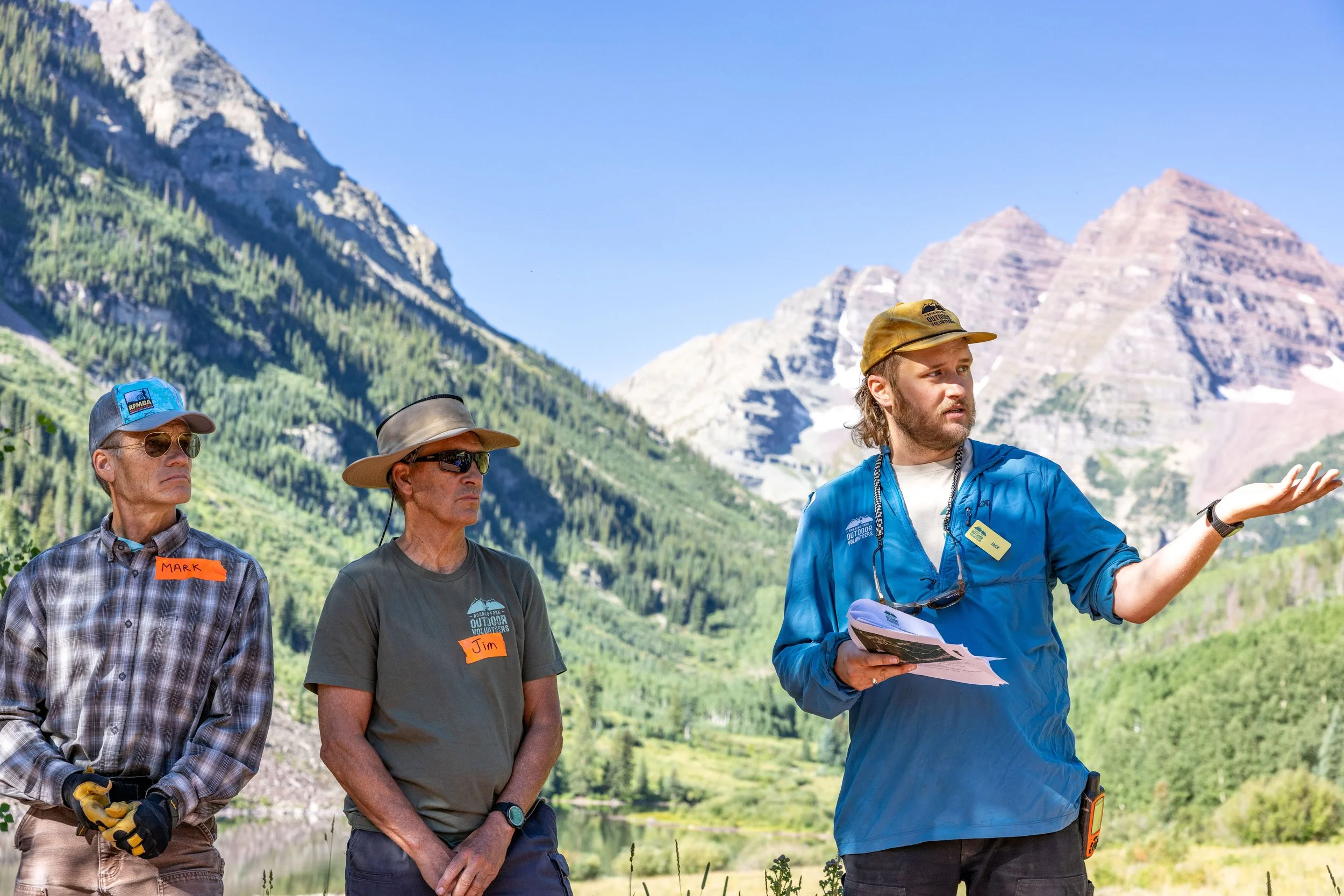
Roaring Fork Outdoor Volunteers (RFOV) participated in many of these listening sessions and joined the coalition’s Community Advisory Committee in early 2025.
Recognizing the urgency created by public land manager funding and staffing cuts, and the need to expand stewardship efforts, the RFOC secured “Early Wins” funding through the state’s Outdoor Regional Partnership Initiative and jumpstart on-the-ground projects.
The result: $87,000 in state funding secured for regional stewardship projects, matched by an additional $45,000 from local governments.
RFOV stepped forward to help convene and co-lead the coalition’s Stewardship Subcommittee, bringing together public agencies and conservation partners including ACES, Aspen Valley Land Trust, Roaring Fork Conservancy, Wilderness Workshop, Forest Conservancy, Roaring Fork Wildfire Collaborative, Roaring Fork Mountain Bike Association, Rocky Mountain Youth Corps, and Independence Pass Foundation.
Together, this group identified priority projects that will deliver meaningful, landscape-scale impact throughout the watershed. By pooling resources and coordinating across jurisdictions, the coalition is directing funding where it is most needed—particularly on heavily used Forest Service and BLM lands.
Funding will support stewardship projects across the region, including:
Trail restoration and maintenance
Habitat and conservation improvements
Resource protection efforts on high-use public lands
Below is a list of the awarded projects (note that one project still needs final approval):
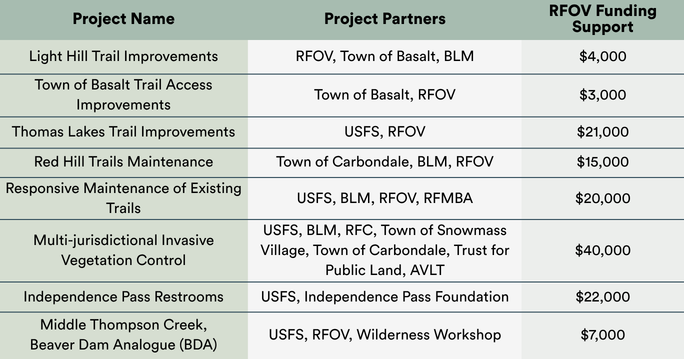
These projects represent more than individual improvements—they demonstrate a new model for collaborative stewardship in the Roaring Fork Valley.
This work also positions the region to pursue much larger investments for conservation and recreation from Great Outdoors Colorado and Colorado Parks and Wildlife beginning in 2027. For RFOV, this effort reflects a core strategic priority: strengthening the valley’s stewardship ecosystem by building partnerships, aligning resources, and bringing people together to care for the places we all love.
We are excited to help lead this work—and grateful for the supporters who make it possible.
